


Throughout our summer series, we have exploring passages of disputing with God found in the Older Testament. Today we move into the Newer Testament, and well, the disputing continues. And this time it’s between a woman and Jesus.
A Canaanite woman – a mother – disputes with Christ because she believes his mercy is also for her and her daughter.
So many stories about Jesus open our hearts to the love and grace of Christ. We hear him call the weary to rest. We see him welcome children. We watch him heal people everyone else avoids and share meals with those called sinners by religious authorities. We know the love found in his death and resurrection. In those stories, we hear so clearly the mercy of Christ.
I don’t know if this passage we just heard is as clear.
The Gospel of Matthew refers to the woman as a Canaanite. By the time of Jesus, that was an ancient name of one of Israel’s oldest enemies. Right as this passage begins, the woman is labeled to be on the outside.
And yet this outsider – the Canaanite woman – recognizes Jesus. She calls him “Lord” and “Son of David,” and cries out, “Have mercy on me. My daughter is tormented by a demon.”
But Jesus doesn’t respond. In fact, he answers her with silence.
I already want to justify this moment; I want explain the discomfort. A mother is pleading for her suffering child, Jesus hears her, and he says nothing.
It’s the disciples who eventually respond but instead of to the woman, they tell Jesus to send her away. Another uncomfortable moment. The disciples do not care about the woman nor her daughter but only that she is crying out and following them. The sound of her bothers them more than the suffering itself.
And then Jesus responds to the disciples, still not to the woman, and says, “I was sent only to the lost sheep of the house of Israel.”
The Gospel of Matthew is trying to name Jesus as Israel’s Messiah. And here a boundary – a border – is created. The woman’s daughter is still suffering, but she is of outside the mission Jesus has named. The Canaanite woman and her daughter are not part of the “house of Israel”.
Another uncomfortable moment.
Still, it doesn’t stop the woman. She kneels before Christ, and she begs him to help her.
And finally, Jesus responds to her, “It is not fair to take the children’s food and throw it to the dogs.”
Jesus is referring to the woman and her daughter as dogs.
I feel like saying this is another uncomfortable moment is too small of a response to what Jesus said to the woman. This is hurtful and degrading
Theologians have spent centuries trying to make these words hurt less, and I understand why. We don’t know how to respond when Jesus says something that puts a person down beneath the table Jesus has seemingly reserved for others.
So I want to offer some explanations that some scholars have come up with… and why they don’t work.
One familiar explanation points out that the Greek word translated as “dogs” can refer to household dogs or puppies rather than street dogs. That may explain why the dogs are close enough to be under the table, but it doesn’t change the arrangement. The children belong at the table, but the woman and her daughter belong underneath it.
Another interpretation says that Jesus is testing the woman. Perhaps he already knows how strong her faith is and wants to draw it out so the others can witness it. That is possible, but the Gospel of Matthew never tells us that this is a test. And we should be careful before telling people who have been ignored or humiliated that perhaps God is doing it to see whether their faith is strong enough.
Others suggest that Jesus is voicing the disciples’ prejudice so they can hear how ugly it sounds. But the text never reveals that. Even if the disciples learn something, the woman and her daughter are still the ones asked to bear the pain of this lesson.
Each understanding was once used to minimize the hurt in this passage, but none of them can truly reverse what Jesus said to the woman. We can honor the wider witness of Scripture and still confess Jesus as Lord without pretending that this moment would’ve been painless for the woman who lived it.
Our love for Jesus should make us more attentive to the woman, not less.
Jesus ignored the woman. The disciples wanted her gone. Jesus said his mission did not include her. And then Jesus compared helping her to giving the children’s bread to dogs.
And so she disputed.
“Yes, Lord, yet even the dogs eat the crumbs that fall from their masters’ table.”
I can actually hear the voice of mothers across the world, “Call me a dog but my child is suffering. You can heal my child, so I will not give up.”
The Canaanite woman pushes backs against Jesus and finds within it a reason for Jesus to change his answer. She doesn’t threaten to take the children’s food, but instead she asks why Israel’s children being fed should require her Canaanite daughter to starve.
That is the flaw she exposes in every theology of scarcity: the belief that mercy given to someone else must mean there is none left for us. If another person belongs, will our belonging be taken away? If another family receives what they need, will there be enough left for mine? If the circle grows wider, will I no longer matter?
Grace is not a loaf of bread that grows smaller whenever another person is fed.
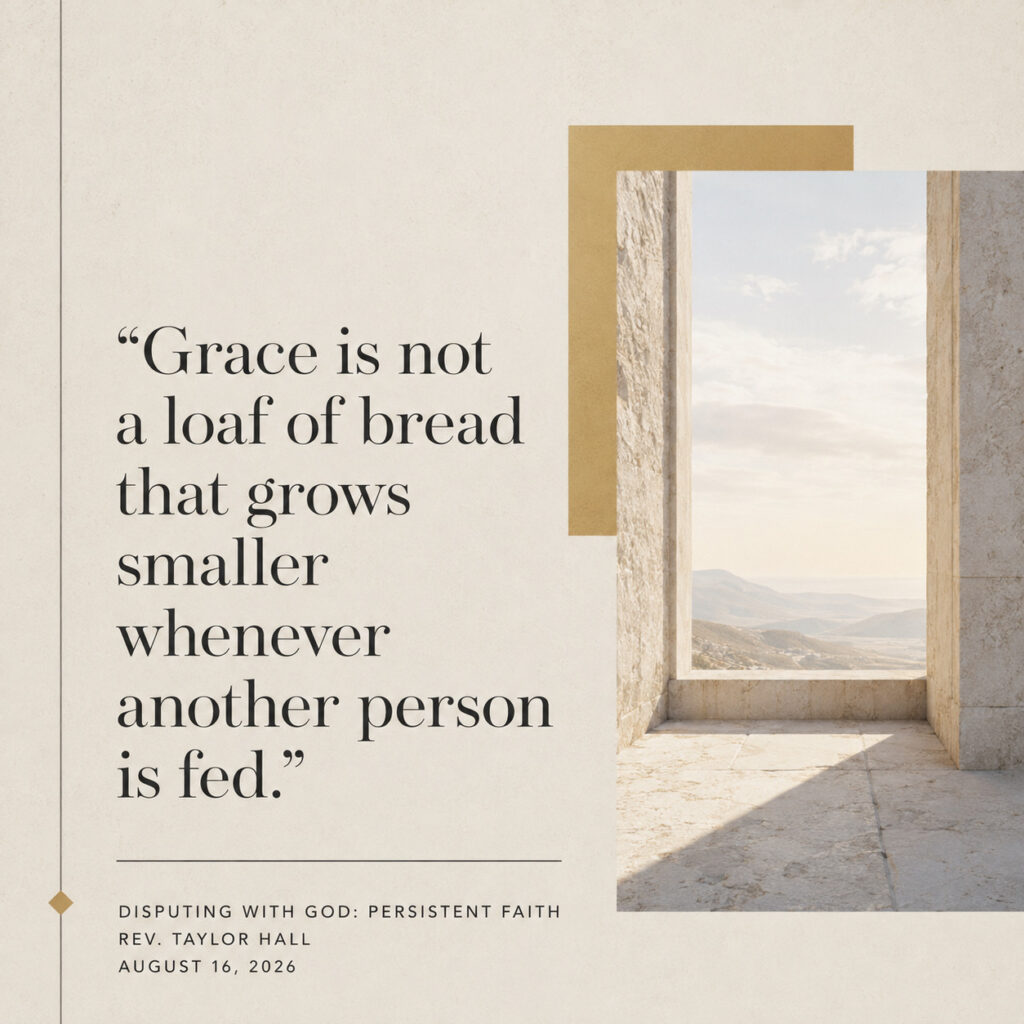
Just before this encounter, Jesus feeds five thousand people and twelve baskets remain; immediately after this encounter, another multitude of 4000 is fed and seven baskets remain. Her story is found between two abundant feasts. The disciples watch bread multiply and still believe there will not be enough. But it is the woman called a dog beneath the table who trusts even the crumbs from Jesus is enough to heal her daughter.
She disputes with Jesus because she believes he can do more.
New Testament scholar Mitzi J. Smith writes, “Never underestimate the power of a persistent woman and the God in whom she believes.”1

And following her dispute, Jesus responds differently, “Woman, great is your faith! Let it be done for you as you wish.”
The Gospel of Matthew doesn’t tell everything happening within Jesus or why he said what he said, but this is what the passage tells us: before she argues, Jesus refuses her request; after she argues, he grants it.
Jesus listens to her. He expands the limit he himself named, praises her faith, and heals her daughter.
We are accustomed to thinking that Christ as Lord means Jesus ruled over every person and whatever he said, even if exclusionary, could not be changed. But the incarnation is also the astonishing claim that God truly entered human life. Jesus as human grew, asked questions, entered relationships, and allowed those relationships to challenge and guide and expand his mission.
The authority of Christ is not so fragile that it must refuse truth when truth comes from a Canaanite woman kneeling before him. Jesus can listen without becoming less than Lord.
Our God allows mercy to be disputed back into view. The woman is not creating mercy within a merciless God, but she is exposing the contradiction between the mercy for which Jesus has become known and the limit he has spoken.
This passage is powerful! Even if it is hurtful, it is powerful. We can argue with Jesus, we can argue with the Word. Especially when the Word, or the interpretation of the word, is exclusionary. These disputes – these arguments – have happened throughout history. Even more recent history.
When people in power called oppression the will of God, those wounded cried out and disputed and fought because they knew the God of mercy is more just and loving than what they were told was the word of God.
Enslaved people were called property while slaveholders used the word of God to justify slavery. Yet enslaved communities sang about the God who heard Israel in Egypt, recognizing freedom in the same book their enslavers used to defend their actions.
Indigenous peoples were told that becoming Christian required them to surrender themselves while Christians conquered and destroyed and called that destruction salvation. Yet they preserved what others tried to erase and remembered that the Creator had known them long before colonizers and missionaries arrived.
Jewish communities endured conversion by force and genocide in the name of a Jewish Messiah. And even during the Holocaust, they kept covenant and trusted God’s faithfulness when Christians betrayed nearly everything Jesus’ name ought to mean.
Women were told the Spirit might give them gifts while the church forbade their use. And yet women preached and served anyway, from pulpits and street corners, challenging how any church that proclaimed resurrection could ignore the lives and ministry of women.
Americans of color were told to wait for freedom and justice until white Christians found the timing convenient. But they prayed, marched, protested, preached, and sang that a gospel that was at peace with white supremacy was no gospel at all.
And LGBTQIA+ people have been told they could have God or tell the truth about themselves, but they could not have both. Denied pulpits and sacraments, marriages and families; still they prayed, loved, studied Scripture, and trusted that God was not the voice demanding they disappear.
Do we hear their cries?
“Call me a dog, property, less than, a criminal, an abomination, a problem but I know who my God is, and I will not give up.”
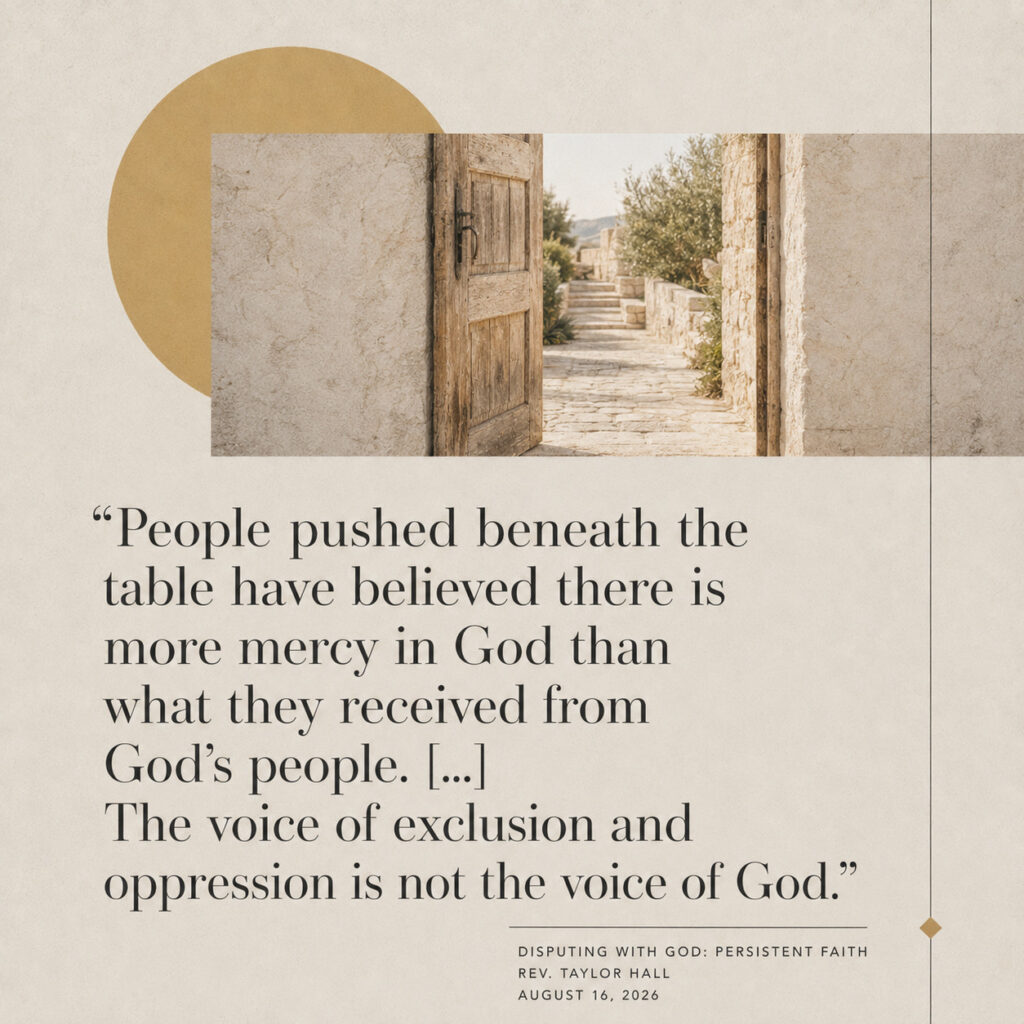
Their persistence exposes exclusion’s lie. People pushed beneath the table have believed there is more mercy in God than what they received from God’s people, that the table was larger than people in power claimed, and that rejection, even when wrapped in Scripture, is not God’s final word.
The voice of exclusion and the voice of oppression is not the voice of God.
Protestants and Presbyterians also belong to this history. We have stood beside people crying for freedom, and we have written theology and policies that gave people reasons to cry out. We must remember both.
How many people have demonstrated extraordinary faith before the church offered crumbs of what should never have been withheld? How many pushed beneath the table became experts in Scripture, policy, law, and medicine just to persuade others that their lives are also loved? How often have we praised people for the persistence our own resistance who made their persistence necessary?
If Jesus moves from refusal toward listening and healing, then the church of Jesus Christ can follow.
The good news is that Christ has not abandoned the church to the smallest version, most exclusionary of itself. God does not reveal the truth about us and then leave us standing alone in our shame, hoping that we can force ourselves to become better people. Because the Spirit is already at work. The Spirit is at work in the voices that interrupt us and in the discomfort that keeps us from returning to gatekeeping the table.
Christ loves the church and its people too much to leave us guarding tables he intends to fill.
Listen for the interrupting cries, look for a person’s dignity, examine our own limits, and use our power and use the love and grace we believe in to make better, more abundant lives for others.
If you have been pushed beneath a table built in God’s name, hear this: Christian rejection is not God’s word about you. Your cry matters, but you should not have to cry before Christians recognize your belovedness. No church, doctrine, policy, or person can undo the love with which God has claimed you.
And if we recognize ourselves among those guarding the table, hear the good news for us as well. Christ has not given up on us. Grace may first reach us as an interruption through a voice we would rather avoid or a truth that makes us uncomfortable.
Because our lives rest in the grace of Christ, we do not have to spend the rest of our lives trying to justify our actions or proving that we were always right. We can listen. We can confess. We can begin making repairs. Another person’s belonging does not threaten our place at the table.
That table belongs to Christ. Its size is not ours to determine, all those invited are not ours to exclude, and its mercy is not ours to ration.
God is gathering all of God’s children to the feast, and God is calling us to do the same.
The Holy Spirit is still at work among us, teaching us to trust the abundance God has proclaimed for so long.
There is enough mercy.
There is enough grace.
There is enough love!
There is room at the table of our Lord.
In the name of the Father, Son, and Holy Spirit. Amen.
Scripture
Watch the Livestream
- Mitzi J. Smith, “Commentary on Matthew 15:[10-20] 21-28,” Working Preacher, August 20, 2017. ↩︎