
For the past couple weeks, Scripture has been leading us through light and epiphanies. This season of light has been one focused on helping us see the world we already live in with greater understanding… or at least a little more clarity.
Two Sundays ago we stood with Isaiah and Matthew in a moment when darkness was all around the people. In first section of Isaiah, the Assyrian empire was advancing and dismantling communities through violence and deportation. Isaiah spoke as the devastation was ongoing and dared to proclaim that light was breaking forth. The Gospel of Matthew then brought us back to the very same region generations later, now living under the Roman empire, where we see Jesus’s ministry after John the Baptist had been arrested. Danger was there! The cost of resistance was already clear. And still, light entered while the empire held power.
Then last Sunday we heard from the prophet Micah and the beginning of Jesus’ Sermon on the Mount. Micah stood before a people shaped by suffering and asked what God actually desires: to do justice, love kindness, and walk humbly with our God. And then in the Gospel of Matthew, Jesus is standing on the hillside speaking blessing over those the world tends to overlook: the poor in spirit, those who mourn, those made powerless, those who hunger for righteousness. Once again in these Scripture passages, we see a little clearer the world God is bringing into view.
This season of Epiphany is revealing a deep conflict between two ways of understanding the world.
The empire tells a very specific story about how we navigate the world. It teaches that the world is governed by force, control, and power. It insists that domination is a characteristic of the strong, blessings are only for those in power, and the suffering of others is deserved as a consequence.
Scripture keeps interrupting that story. Over and over, God reveals a world shaped by compassion, justice, humility, and shared life together. God’s light helps us see what is out there beyond ourselves. It shines bright and illuminates the dark… and it reveals the shadows.
I’m reminded of this most mornings in my apartment. I have two large windows that face east, and when the sun comes up, the light pours in. It’s beautiful and warm and fills nearly my entire apartment. My dog Odin loves it. He finds the exact spot where the light hits just right and settles in. When it’s not winter, he takes himself out onto the balcony to sunbathe. He has a very easy life.
And then the light keeps moving.
My apartment also has hardwood floors, and while I keep things relatively clean, that same beautiful light reveals everything. Crumbs and dust bunnies. And lots of dog fur that Odin swears is not his. None of this suddenly appeared when the sun came up. But the light made visible what was already there, what had been easy to miss in a dimmer light.
Light reveals what is there. Sometimes what it reveals is lovely. And sometimes it reveals things we would have preferred not to see so clearly. But once the light hits the floor, pretending everything is fine becomes much harder.
God’s light works the same way in the world. When God shines that light, it doesn’t suddenly create hunger or fear or injustice. Those realities were already present. But the light makes them harder to ignore.
That’s why the empire prefers this light a little dimmer. Not darkness exactly, but just enough light to function without revealing the path forward. Just enough distance that hunger can be discussed without being addressed. Just enough abstraction that people without housing become statistics rather than neighbors. Just enough twisted stories of truth and power that make the people believe violence and evil are good and necessary. The empire wants just enough light so that the people begin to believe the empire is the source of that light.
But then Jesus speaks about salt and light in a world that already knows the empire very well.
Salt is ordinary and essential. It preserves food, it enhances, it is used in purification. Salt by itself is not exactly good, but the absence of its effect is immediately noticed. When salt is used, things last longer.
Light functions the same way. It does not belong to itself. It belongs to the space it enters. Someone from the Wednesday Bible study pointed out that light is most effective when lit in complete darkness. For example, you would turn a light on in a room so that you can find your way safely through it. It helps us see where we are and how to move through the space safely. Light reveals the conditions for care.
When listening to Jesus’ Sermon on the Mount, the people gathered on a hillside are already shaping the world around them by being present in God’s reign. Their very presence is interrupting the powers of the empire.
However, the presence of the people found in the book of Isaiah is different.
In the third section of Isaiah, God’s people have returned from exile, and the people are once again praying and fasting and worshipping. But they are feeling very distant from God so they question why that might be.
First, for a quick explanation on fasting. Fasting in the ancient world embodied an act of humility. People fasted to place themselves physically and spiritually before God. It was a way of saying, with the body as much as with words, I am not self-sufficient. I need God.
Over time fasting had become closely tied to worship itself. It was one of the clearest ways people expressed devotion and repentance. But when the people began fasting while others in their community were still going hungry and thirsty without shelter or clothing, God makes it known that this fast is not worship. A fast that promotes one’s own self-righteousness while ignoring human need is not a fast acceptable to God.
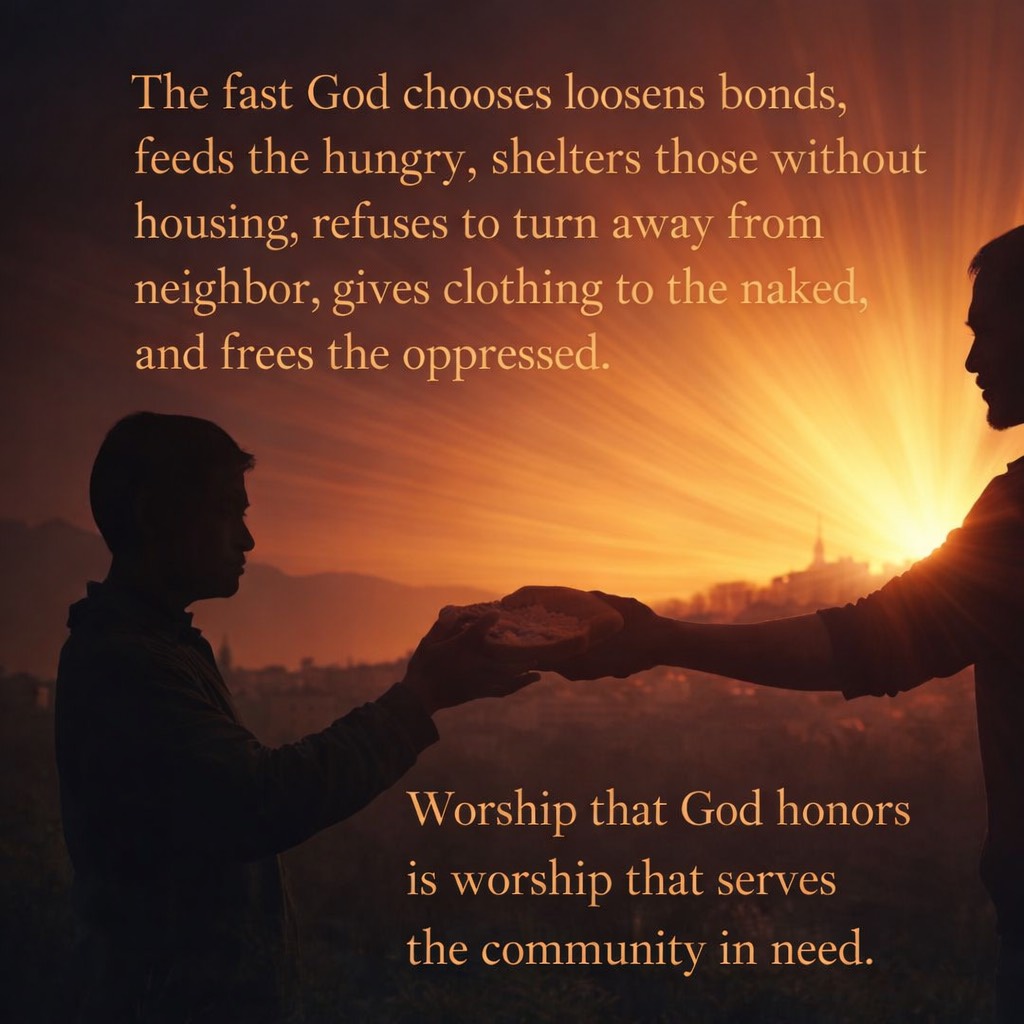
So God gives the people a very clear directive. The fast God chooses loosens bonds, feeds the hungry, shelters those without housing, refuses to turn away from neighbor, gives clothing to the naked, and frees the oppressed. Worship that God honors is worship that serves the community in need.
Only then does Isaiah speak again of light: “Then your light shall rise in the darkness and your gloom be like the noonday.”
Light breaks forth when worship is brought to the people in need through service and humility. The prophet Isaiah uses God’s words to confront the brokenness of the world. He refuses to let worship remain disconnected from the places where that brokenness is seen most clearly. And this is so important to us.
I want to believe that most people are doing the best they can in this world. I refuse to let go of this. I want to believe that most people are capable of goodness. That people do love and they do care. I want to believe that compassion is still more common than cruelty. This belief is rooted in the conviction that people are created in the image of God.
At the same time, I am not willing to ignore the reality of evil. There is real wickedness in the world. There is still an empire. There are people and systems choosing cruelty and violence against people with less power. And the truth is, it always has kind of been there, hasn’t it? Genocide. Slavery. Women’s rights. Civil rights. How we treat immigrants and refugees. Queer people. Those incarcerated. The poor. The disabled. But now actions are recorded on videos. It is too easy and almost expected for everything to be posted online. And even in online posts, in tweets or whatever they are called now, people speak with such evil to dehumanize others.
What we are witnessing is not the sudden appearance of evil, but its exposure. God’s light is bright enough now that what once hid is being seen clearly. And perhaps this, too, is part of Epiphany.
The light right now is strong enough to show us the cruelty and oppression and abuses of power so clearly. It is bright enough to show us who benefits from the empire and who bears its cost.
But if I – and you – believe most people are capable of good, then the fast we choose is to live as if that goodness matters. And if we long for a world shaped by justice and mercy, then we participate in the hope by doing what Isaiah names.
We let our light shine when we act in service for others.
As part of our service today, we are asking for God’s blessing over our Scouts. Scouting organizations help young people practice goodness and compassion; showing that character and how you treat others matters.
In a culture that often rewards domination; lifting up trustworthiness, loyalty, helpfulness, kindness, courage, and reverence resists the very domination we witness in the world.
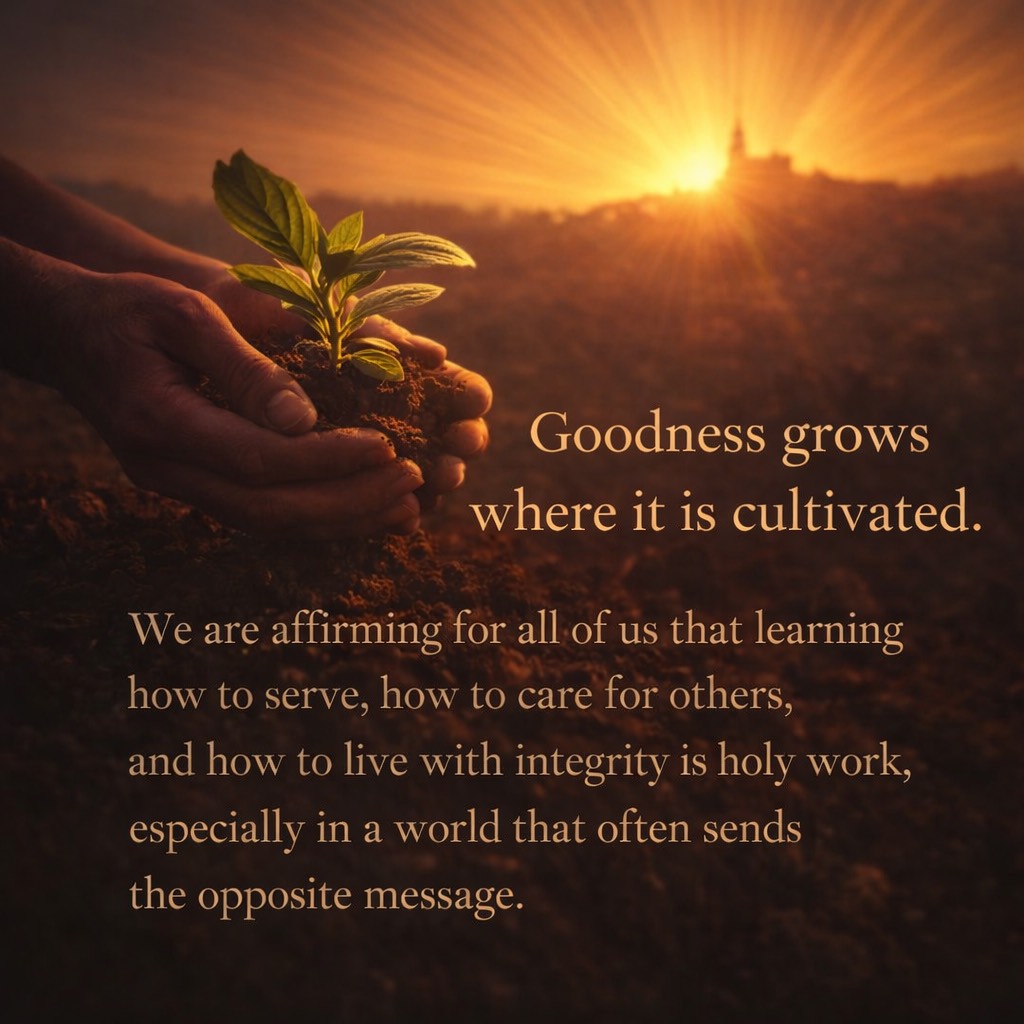
When we bless our Scouts today, we are giving thanks that goodness grows where it is cultivated. We are affirming for all of us that learning how to serve, how to care for others, and how to live with integrity is holy work, especially in a world that often sends the opposite message.
And this brings us back to the light on the floor. The morning sun in my apartment reveals what is there and makes it possible to respond with care. Once the dust and crumbs and fur are visible, something simple and human follows. I sweep. I clean. I pick things up. I tend to what the light has made visible because I am now responsible for what I can no longer pretend I haven’t seen.
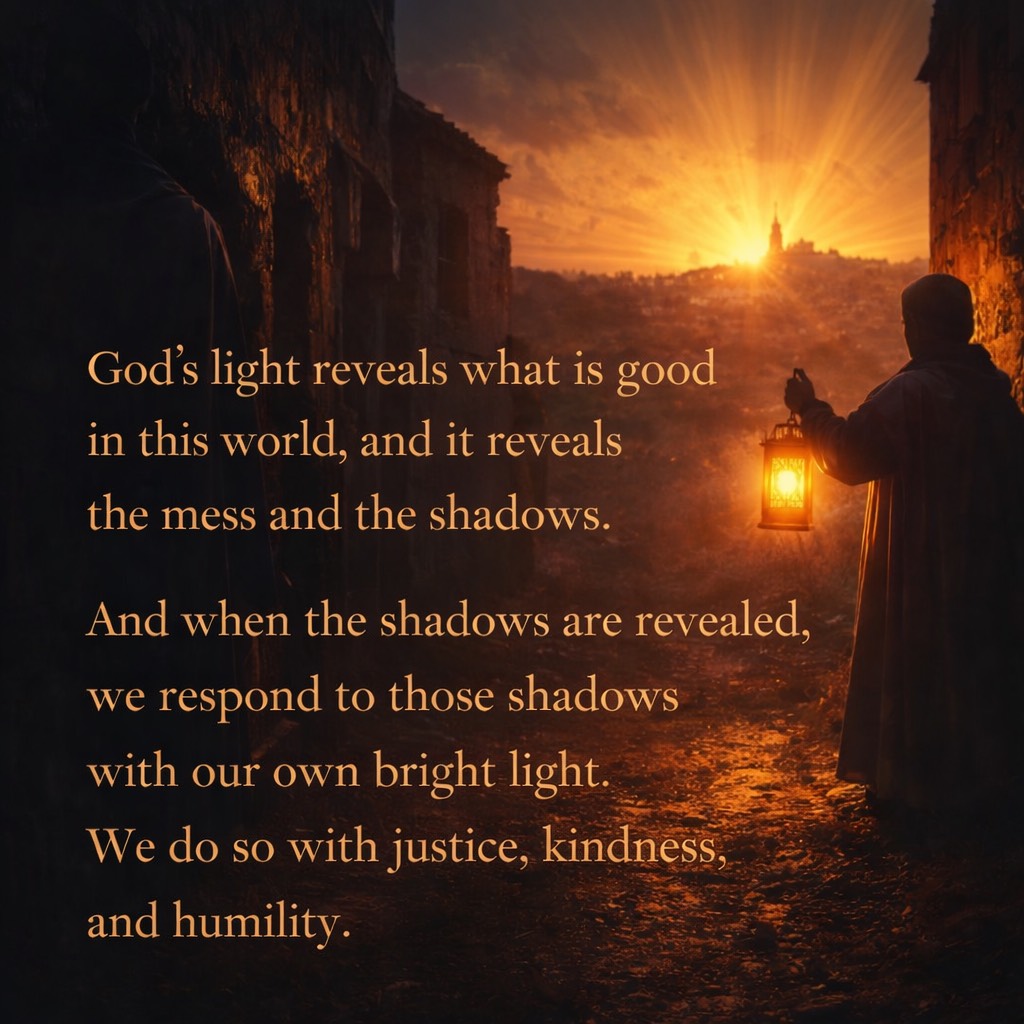
God’s light enters the spaces where we exist and changes how we move within them. God’s light reveals what is good in this world, and it reveals the mess and the shadows. And when the shadows are revealed, we respond to those shadows with our own bright light. We do so with justice, kindness, and humility.
This is the fast God chooses for us. This is the way we embody worship. This is the light of God that shines through us.
Amen.
Where has God’s light helped you see more clearly recently? What will you do about it?